Introduction
When the label of a financial prediction problem is a forward h-period return, consecutive training samples share h-1 of their h label returns. [15] argues that this overlap leaks information between cross-validation folds, inflates measured performance, and is one reason backtested strategies fail in production; his prescription—purged k-fold cross-validation with an embargo—has become standard practice in financial machine learning, shipped in widely used open-source libraries and adopted essentially on textbook authority. The supporting evidence, however, is illustrative rather than quantitative: how large the bias actually is, what data properties control it, and how much of it each component of the remedy (contiguous folds, purging, embargo) removes have not been measured.
The question is sharper than it looks, because a neighboring literature says the opposite. [5] prove that standard k-fold cross-validation is valid for purely autoregressive prediction with uncorrelated errors, and empirical comparisons [4, 8] repeatedly find vanilla or blocked CV competitive with the out-of-sample evaluations [17] that practitioners trust. If naive CV is provably fine for time series in those settings, the case for aggressive purging must rest on a specific mechanism that those settings lack—and identifying that mechanism is a prerequisite for knowing when purging is necessary, when it is harmless insurance, and when it wastes data.
This paper measures the mechanism directly.1 We build a simulation in which the true predictability of every feature is known exactly—including the case of exactly zero—and define leakage operationally: the cross-validated skill estimate minus the true forward skill of the very same fitted models, measured on an untouched continuation of the series. Because the truth is known, “phantom skill” is not an interpretation but a number, with a confidence interval, as a function of the label horizon h and the feature persistence \phi.
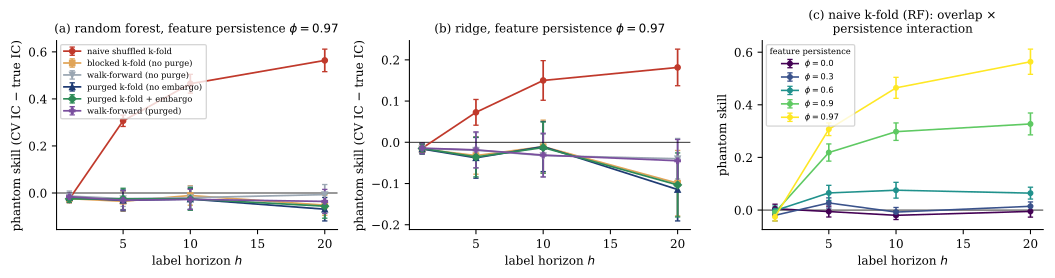
The headline result is an interaction that reconciles the two literatures. Overlap alone does not create phantom skill: with serially independent features, naive shuffled k-fold shows no optimistic bias in IC at any horizon we test. Persistence alone does not create it either: with non-overlapping labels (h=1), even features with \phi=0.97 produce nothing. The leak requires the product: a persistent feature lets the model locate a test sample’s temporal neighbors in feature space, and the overlapping label tells it what those neighbors’ labels (mostly) were. Autoregressive setups of the Bergmeir line live on the two harmless axes; h-period forward labels with persistent predictors—the standard financial configuration—live in the interaction region, where we measure phantom information coefficients up to +0.56 for a random forest under a null with exactly zero true signal. Both literatures are right in their own regime, and the boundary between the regimes is the product of overlap and persistence.
Measuring the remedy against the same ground truth produces three findings that practitioners may find uncomfortable in opposite directions. First, blocked k-fold—contiguous test blocks, no purging at all—already removes nearly all of the mean bias; at h \ll T, purging’s marginal contribution to calibration is second-order, and what it actually buys is the worst case (zero overlapping pairs by construction), not the average. Second, the embargo bought nothing anywhere in our design: purged k-fold is already calibrated at zero embargo in every arm, including genuine signals with persistence up to 0.995, and the embargo sweep is flat. We are explicit about scope: our features are exogenous AR(1) processes, and the case the embargo exists for—features derived from past returns, whose serial dependence echoes the label beyond the overlap window—is deliberately out of scope here. Third, the place where purging pays unambiguously is model selection: scored by naive CV, the model menu is ranked by leakage-harvesting ability rather than true skill, and the worst true model wins every time; scored by purged CV, the truly best model wins most often, and the deployed skill more than triples.
Contributions.
A reproducible known-truth framework for leakage measurement: a data-generating process with overlapping forward labels and AR(1) features whose population information coefficient is available in closed form (including exactly zero); a forward-truth protocol that scores each fold’s fitted model on an untouched continuation separated by an h-step gap; and from-scratch splitter implementations whose zero-overlap property is verified by an exhaustive train/test pair checker (Sections 3–4).
A quantification of phantom skill under the null as a function of (h,\phi), showing it is an interaction—absent at h=1 for any \phi and at \phi=0 for any h, up to +0.564\pm0.048 IC when both are present—and model-dependent (random forest absorbs roughly three times more of the leak than ridge; the same pattern holds for classification AUC). This measurement offers, to our knowledge, the first joint account of the [5] validity results and the financial-ML failure mode—by analogy rather than replication: the Bergmeir-line experiments use endogenous lagged-target features, a class our embargo discussion declares out of scope, so we explain why their settings sit on the harmless axes rather than re-run them (Section 6.1).
A decomposition of the remedy: contiguous blocks alone remove nearly all mean bias; purging adds the worst-case guarantee at a 1.2\% data cost; the embargo adds nothing for exogenous features, a deliberately disclosed negative result (Sections 6.2–6.3).
A cost accounting—training data discarded, CV-estimate dispersion, walk-forward’s data efficiency—showing the dispersion price of the honest procedure comes from contiguity, not from the purge (Section 6.4).
A demonstration that the bias becomes a wrong decision at the model-selection stage, and that purged CV repairs the decision, not just the estimate: true forward IC of the selected model 0.012 \to 0.042 against an oracle of 0.069 (Section 6.5).
Related work
Cross-validation under dependence.
The difficulties serial dependence creates for cross-validation were identified long before financial machine learning popularized them. [7] introduced h-block cross-validation, deleting the h observations on either side of each test point so that the training set is approximately independent of it, and [16] extended this to hv-block cross-validation, additionally removing a contiguous validation block and proving consistency of model selection for general stationary processes. Both constructions are direct ancestors of the purging-and-embargo procedure now standard in finance, yet neither paper quantifies how much optimistic bias the deleted observations would otherwise contribute for a given dependence structure—h is treated as a tuning constant, not a measured requirement. The broader theory of cross-validation, including its known failure modes, is surveyed by [1], who note that the i.i.d. assumption is load-bearing for most risk-estimation guarantees and that corrections for dependent data remain comparatively underdeveloped.
Evaluation protocols for time-series prediction.
In forecasting, the default response to dependence has been out-of-sample (walk-forward) evaluation [17]. [4] compared blocked and standard cross-validation against out-of-sample evaluation across simulated and real series and found, perhaps surprisingly, that cross-validation variants were competitive and often preferable on efficiency grounds. [5] sharpened this into a theoretical result: for purely autoregressive models with uncorrelated errors, standard k-fold cross-validation is valid—the feared temporal leakage does not materialize. Large-scale comparisons by [8] complicate the picture further, finding that the best protocol depends on series length and stationarity. This line of work sits in unresolved tension with financial practice: if naive cross-validation is provably fine in autoregressive settings, the case for aggressive purging must rest on a specific leakage mechanism—and that mechanism, we show, is the overlapping forward-return label combined with persistent features, not autocorrelation of the target per se. Our controlled design isolates exactly that combination and maps the boundary between the two regimes.
Purging, embargo, and backtest overfitting in finance.
[15] gives the canonical statement of the problem in financial machine learning: when labels are computed from forward windows of returns, observations whose label intervals overlap leak information between training and test folds, inflating measured performance; his Chapter 7 prescribes purged k-fold cross-validation with an embargo as the remedy. The prescription has been adopted essentially on textbook authority—implementations ship in widely used open-source backtesting libraries—but the supporting evidence is illustrative rather than quantitative. Closely related is the literature on backtest overfitting: [2] showed how multiple testing over strategy configurations manufactures spurious Sharpe ratios, and [3] operationalized this as the probability of backtest overfitting, estimated via combinatorially symmetric cross-validation. [11] document a complementary channel, the mining of the in-sample/out-of-sample split point itself. These papers quantify selection-induced phantom skill; none measures the split-induced phantom skill that purging targets, nor how the two interact when leaky validation scores feed a model-selection step—the interaction our Section 6.5 measures directly.
Leakage as a general ML failure mode.
Outside finance, [14] provided the standard formulation of leakage in data mining: the use of information at training time that would be illegitimately unavailable at deployment. [9] demonstrated a structurally identical phenomenon in activity recognition, where similarity between temporally adjacent windowed records biases cross-validation upward, and proposed meta-segmented folds—effectively purging by another name. [13] survey leakage across seventeen scientific fields and identify it as a principal driver of the reproducibility crisis in ML-based science, but their taxonomy stops at detection and avoidance; the magnitude of bias attributable to a given leakage channel, as a function of measurable data properties, is left open.
Overlapping observations in econometrics.
That overlapping forward returns induce dependence is classical econometrics. [10] derived corrected inference for regressions with overlapping horizons, [12] showed that long-horizon predictive regressions suffer severe small-sample distortions under overlap and proposed alternative standard errors, and [6] offered a transformation-based improvement. This literature solved the inference problem—standard errors under overlap—decades ago. Its evaluation analogue, the bias the same overlap induces in cross-validated estimates of predictive skill and in the model selections made from them, has no comparable treatment.
Gap.
Across these literatures the pieces of our question exist but have never been assembled. The statistics literature supplies blocked and purged estimators without measuring what they remove; the forecasting literature shows naive CV can be unbiased in autoregressive settings, seemingly contradicting financial practice; the econometrics literature characterizes overlap-induced dependence for inference but not for evaluation. To our knowledge, no study has measured, in a controlled known-truth design, (i) the magnitude of phantom skill under naive, blocked, purged-embargoed, and walk-forward splitting as a joint function of label overlap and feature persistence; (ii) the embargo actually required, rather than the rule-of-thumb 1\%; (iii) the data and dispersion costs purging imposes; and (iv) the downstream model-selection consequences when leaky scores choose among candidates. Quantifying these is the contribution of this paper, and it simultaneously reconciles the Bergmeir-line validity results with the finance-community prescription: both are correct in their respective regimes, and we map the boundary between them.
Overlap leakage and the splitters under test
Labels and information intervals.
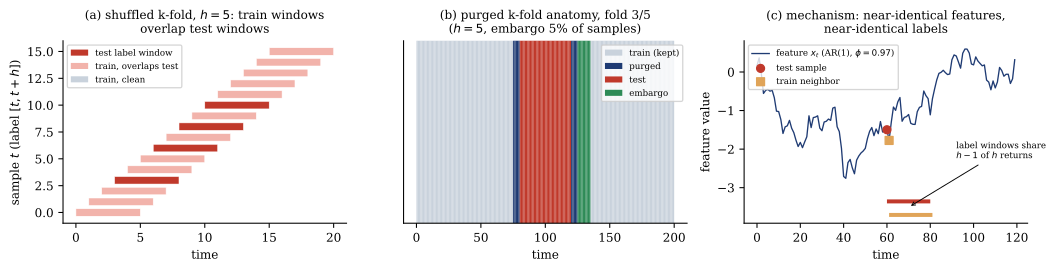
Time is indexed by observations t = 0, 1, \dots Let r_t denote the return realized over the step ending at t, and let features be observable at t. The label of sample t is the forward h-period cumulative return \begin{equation} y_t \;=\; \sum_{u=t+1}^{t+h} r_u , \label{eq:label} \end{equation} so for h>1 consecutive samples share h-1 of their h label returns. Each sample carries an information interval I_t = [t,\, t+h], which conservatively includes the decision time t and the last return time t+h. Two samples s, t overlap iff I_s \cap I_t \neq \emptyset. Overlap is the leakage channel under study: if a training sample’s interval intersects a test sample’s interval, part of the test label’s realized randomness is present in the training label.
The splitter suite.
All splitters partition the T in-sample times into k test folds and assign training sets; we compare six (Figure 1):
naive shuffled k-fold: a uniformly random partition into k test folds, train = rest—the i.i.d. textbook procedure, deliberately wrong here;
blocked k-fold: contiguous, equal test blocks; train = everything outside the block, without purging, so overlapping pairs survive at the two boundaries of every test block;
purged k-fold: contiguous test blocks; every training candidate i whose interval [t_i, t_i+h] intersects the union of the test block’s intervals is purged [15];
purged k-fold + embargo: additionally, training candidates after the test block whose time index lies within \max_{j \in \text{test}}(t_j + h) + E are dropped, where E = \lfloor \varepsilon T \rceil and \varepsilon is the embargo fraction. The embargo is one-sided (after the block), extending the right-side purge window—the convention of [15] and of the reference open-source implementations;
walk-forward: expanding-window splits; train on [0, b), test on the next contiguous block starting at b; the first 40\% of the sample is never tested. Without purging, the training tail’s label windows run into the test block—a boundary leak;
walk-forward purged: as above, dropping training samples with t_i + h \geq b.
All six are implemented from scratch in the released package. Correctness is not assumed: an exact checker counts, for every (train, test) pair in every fold, whether the two information intervals intersect; the purged splitters produce zero overlapping pairs on every configuration in the test suite, exhaustively. The same checker quantifies how many overlapping pairs the naive and blocked splitters retain.
Simulation framework
Data-generating process.
Every experiment runs on a synthetic series whose true predictability is known exactly. Returns follow \begin{equation} r_{t+1} \;=\; \beta\, s_t \;+\; \sigma\, \epsilon_{t+1}, \qquad \epsilon_t \stackrel{\text{iid}}{\sim} \mathcal{N}(0,1),\; \sigma = 1, \label{eq:dgp} \end{equation} where s_t is a latent unit-variance AR(1) signal, s_t = \phi_s\, s_{t-1} + \sqrt{1-\phi_s^2}\,\eta_t. Features are of two kinds, both AR(1) with exactly unit stationary variance. Noise features (five columns in the null and classification grids, four in the signal arms) are independent AR(1) processes with persistence \phi, generated independently of the return series: their true predictive power is exactly zero, so any measured CV skill on a noise-only configuration (\beta = 0) is leakage or sampling noise. The signal feature, present only in genuine-signal configurations, is the latent state s_t itself (optionally observed with noise; noiselessly here). Labels are the overlapping forward sums of Eq. (label); a binary label \mathbf{1}\{y_t > 0\} is also produced for the classification arm. Crucially, all features are exogenous: none is computed from past returns. This isolates the pure overlap channel; features derived from returns (rolling means, volatilities) would add a second dependence channel that we deliberately exclude and discuss in Section 8.
Closed-form population truth.
For the single-signal configuration the population Pearson correlation between the observed feature f_t and the h-period label is available in closed form: \begin{equation} \mathrm{IC}_{\mathrm{pop}} = \frac{\beta\, g_h}{\sqrt{\big(1+\nu^2\big)\big(\beta^2 V_h + h\sigma^2\big)}}, \qquad g_h = \sum_{j=0}^{h-1}\phi_s^{\,j}, \qquad V_h = h + 2\sum_{d=1}^{h-1}(h-d)\,\phi_s^{\,d}, \label{eq:popic} \end{equation} with \nu the observation-noise standard deviation (\nu = 0 here). For noise-only configurations \mathrm{IC}_{\mathrm{pop}} = 0 exactly. We invert Eq. (popic) to calibrate \beta so that every genuine-signal arm has the same population IC of 0.10 regardless of its persistence \phi_s—so arms differ only in the property under study.
Forward-truth protocol.
Each experiment generates T in-sample observations handed to the CV schemes, followed by an h-step gap (so no label window crosses the boundary), followed by T_{\text{hold}} = 5{,}000 forward observations that no CV procedure ever touches. For each (splitter, model) pair we record: the CV estimate—the pooled out-of-sample IC (Pearson correlation of cross-validated predictions with realized labels; AUC for classification) exactly as a practitioner would compute it; the truth—each fold’s fitted model evaluated on the forward holdout, averaged across folds; and \begin{equation} \text{leak} \;=\; \text{CV estimate} \;-\; \text{truth}. \label{eq:leak} \end{equation} Under the null the population truth is zero (AUC: 0.5) and the measured forward truth is statistically indistinguishable from it, so the mean leak in a cell is the phantom skill of that cell. Positive leak is optimism; negative leak is pessimism, which we report but do not count as leakage to be embargoed away. Everything is deterministic given the released seeds.
Experimental setup
All schemes use k=5 folds; the “purged + embargo” scheme uses the common default \varepsilon = 2\% except in the embargo sweep, where \varepsilon is the design variable; walk-forward never tests the first 40\%. Regression models are ridge (\alpha=1) and a random forest (30 trees, depth 6, minimum leaf 5); classification uses logistic regression and a random-forest classifier of the same shape. Four batches:
Null grid (the headline surface): noise-only configurations crossing h \in \{1,5,10,20\} with \phi \in \{0, 0.3, 0.6, 0.9, 0.97\}, 16 repetitions per cell, in-sample length T drawn per repetition from \{800, 1600, 2400\}, five noise features; all six splitters \times both regression models: 3{,}840 records.
Embargo sweep: purged k-fold with \varepsilon \in \{0, 1, 2, 4, 8\}\% at h=10, T=1600; four genuine-signal arms with \phi_s \in \{0.6, 0.9, 0.97, 0.995\} and \beta calibrated to \mathrm{IC}_{\mathrm{pop}} = 0.10 (plus four noise features, \phi = 0.9), and one noise-only arm; 24 repetitions per arm: 1{,}200 records. An arm is calibrated at \varepsilon if its mean leak is \le 0.01 or its 95\% CI contains zero.
Model selection: genuine-signal configuration (T=2000, h=10, \phi_s = 0.97, \beta = 0.036, \mathrm{IC}_{\mathrm{pop}} = 0.100, four noise features with \phi=0.9) and a five-model menu—ridge, random forests of depth 3 and 8, and kNN with k=10 and k=50. In each of 50 repetitions both naive and purged(+2\% embargo) CV score the menu and select the argmax; every candidate’s true forward skill is measured by refitting on all in-sample data and scoring on the holdout: 50 records.
Classification check: noise-only configurations at h=10, T=1500, \phi \in \{0, 0.9\}, 20 repetitions, naive vs. purged+embargo, both classifiers: 160 records.
In total 5{,}250 (splitter, model, series) evaluations. All intervals are normal-approximation 95\% confidence intervals across repetitions. The information coefficient is the primary metric throughout; a sign-strategy Sharpe is recorded as a secondary descriptive metric. The Sharpe broadly tracks the IC pattern in the product region, but it is not a clean interaction in the IC sense: the Sharpe of overlapping PnL has its own bias channel, and the naive splitter shows a significant phantom Sharpe even on the \phi=0 axis at long horizons (e.g. +0.098\pm0.056 at h{=}20, \phi{=}0), so we do not rely on it for the interaction claim.
Results
Phantom skill under the null is an interaction
Table 1 is the headline measurement: the phantom skill (mean leak, Eq. (leak)) of naive shuffled k-fold with a random forest, on features with exactly zero true predictive power, across the (h, \phi) grid. Figure 2 shows the same surface graphically alongside the other splitters.
| feature persistence \phi | |||||
| horizon | 0 | 0.3 | 0.6 | 0.9 | 0.97 |
| h=1 | +0.005 \pm 0.017 | -0.020 \pm 0.022 | -0.002 \pm 0.017 | -0.009 \pm 0.016 | -0.026 \pm 0.016 |
| h=5 | -0.006 \pm 0.021 | +0.027 \pm 0.019 | +0.065 \pm 0.029 | +0.219 \pm 0.033 | +0.307 \pm 0.024 |
| h=10 | -0.020 \pm 0.016 | -0.008 \pm 0.018 | +0.075 \pm 0.030 | +0.298 \pm 0.033 | +0.465 \pm 0.040 |
| h=20 | -0.005 \pm 0.022 | +0.014 \pm 0.017 | +0.064 \pm 0.023 | +0.327 \pm 0.042 | +0.564 \pm 0.048 |
Three observations. First, the interaction is exact within sampling noise: across the entire h=1 row the largest phantom skill is +0.005 (any \phi), and across the entire \phi=0 column the largest is +0.005 (any h). Overlapping labels with serially independent features produce nothing—the model has no way to locate a test point’s temporal neighbors, so the shared label content is unreachable. Persistent features with non-overlapping labels produce nothing—the neighbors are locatable but their labels share no randomness with the test label. This is precisely the reconciliation: the autoregressive settings in which [5] prove naive CV valid, and in which [4] found it empirically competitive, sit on these two axes; the standard financial configuration (h-period forward labels, persistent predictors) sits in the product region.
Second, in the product region the bias is enormous relative to any realistic signal: +0.307 \pm 0.024 at (h{=}5, \phi{=}0.97), rising to +0.564 \pm 0.048 at (h{=}20, \phi{=}0.97)—an order of magnitude larger than the information coefficients real strategies exhibit, and positive in 16 of 16 repetitions in every cell with h \ge 5, \phi \ge 0.9.
Third, the leak is model-dependent in the direction the mechanism predicts: the more local and flexible the model, the more of the leak it absorbs. Ridge regression, which cannot memorize individual neighbors, shows roughly one third of the random forest’s phantom at the same cells (+0.073, +0.150, +0.182 \pm 0.044 at h = 5, 10, 20 with \phi = 0.97). The classification arm behaves identically in AUC units: at \phi = 0.9, h = 10, a naive-CV random-forest classifier reports AUC 0.623 against a true forward AUC of 0.504—phantom AUC +0.119 \pm 0.010—while logistic regression shows +0.042 \pm 0.014; at \phi = 0 both are zero (-0.008 \pm 0.011 and -0.011 \pm 0.012), and under purged-with-embargo CV both are slightly pessimistic everywhere (-0.026 to -0.044).
Blocking alone removes nearly all of the mean bias
Table 2 compares all six splitters two ways: their worst (most optimistic) cell anywhere on the 4 \times 5 grid, and their leak at the most leak-prone cell, (h{=}20, \phi{=}0.97), where naive k-fold shows +0.564.
| worst cell over grid | at h{=}20, \phi{=}0.97 | |||
| Splitter | RF | ridge | RF | ridge |
| naive shuffled k-fold | +0.564 \pm 0.048 | +0.182 \pm 0.044 | +0.564 \pm 0.048 | +0.182 \pm 0.044 |
| blocked k-fold (no purge) | +0.004 \pm 0.019 | +0.008 \pm 0.024 | -0.052 \pm 0.043 | -0.099 \pm 0.079 |
| purged k-fold | +0.009 \pm 0.019 | +0.008 \pm 0.024 | -0.069 \pm 0.050 | -0.115 \pm 0.076 |
| purged k-fold + embargo | +0.009 \pm 0.019 | +0.009 \pm 0.024 | -0.056 \pm 0.051 | -0.103 \pm 0.078 |
| walk-forward (no purge) | +0.016 \pm 0.017 | +0.012 \pm 0.021 | -0.007 \pm 0.043 | -0.040 \pm 0.049 |
| walk-forward purged | +0.015 \pm 0.015 | +0.012 \pm 0.021 | -0.036 \pm 0.051 | -0.045 \pm 0.052 |
The result we did not expect to be this clean: blocked k-fold without any purging already removes essentially all of the mean bias. Its worst cell anywhere on the grid is +0.004 \pm 0.019 (RF) and +0.008 \pm 0.024 (ridge)—both at h=1, where no overlap exists, i.e. sampling noise—and at the cell where naive CV hallucinates +0.564, blocking alone shows -0.052 \pm 0.043. The arithmetic explains why: with contiguous test blocks, overlapping train/test pairs survive only within h samples of the two block boundaries, a O(h/T) fraction of pairs, versus O(1) under shuffling. At h \ll T the surviving boundary leak is second-order in the mean. Unpurged walk-forward behaves the same way (+0.016 worst, one boundary per fold). What purging changes in the mean, at these horizons, is statistically nothing; what it changes structurally is the guarantee—the exhaustive pair checker certifies zero overlapping pairs, for any h, any fold geometry, any future configuration in which h is not small relative to the block length. We state this honestly as the paper’s mildly contrarian finding: at h \ll T, contiguity does the calibration work, and purging is cheap insurance on the worst case rather than a correction of the average.
The residuals of all contiguous schemes at high (h,\phi) are negative: blocked, purged, and embargoed k-fold sit between -0.05 and -0.12 at (h{=}20, \phi{=}0.97). This is contiguous-fold pessimism, not residual leakage: with strongly overlapping labels a test block contains few effectively independent label windows, and a model fit outside the block regresses toward its own training period, so the pooled CV correlation systematically underestimates the same models’ forward skill on a long holdout. Two caveats scope this. First, the magnitude is specific to the pooled-prediction convention we adopt as “what a practitioner computes”: scoring each fold’s IC separately and averaging shrinks the pessimism substantially, because much of it comes from pooling predictions across heterogeneous contiguous folds rather than from the splits themselves. Second, the direction is what matters for practice: the honest procedure does not merely remove the optimism; under the pooled convention it leaves an estimate that is, if anything, slightly conservative—a property practitioners should budget for (or sidestep by fold-averaging) rather than “fix” by un-purging.
Purging is calibrated at zero embargo; the embargo bought nothing here
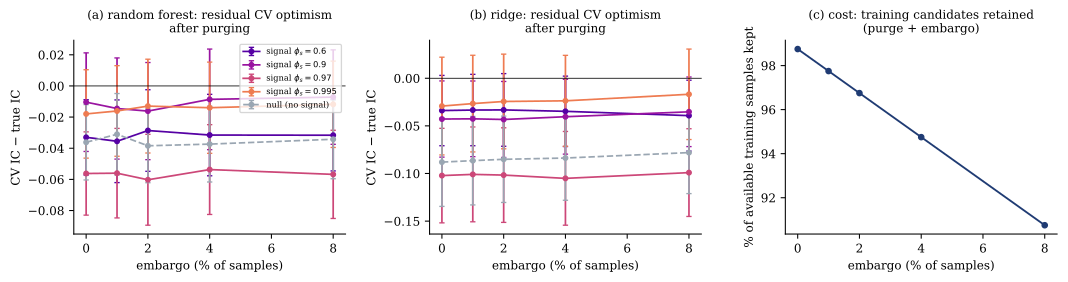
The embargo sweep asks the textbook question directly: after purging, how much embargo is required before residual CV optimism disappears? In this design the answer is none, in every arm (Figure 3). At \varepsilon = 0, all ten (arm, model) combinations—four genuine-signal persistence levels up to \phi_s = 0.995 plus the null arm, each under both models—already meet the calibration criterion. The residual leak at zero embargo ranges from -0.010 to -0.102: every single one is negative (the contiguous-fold pessimism of Section 6.2), so there is no optimism left for an embargo to remove. And the sweep is flat: across the entire grid \varepsilon \in \{0, 1, 2, 4, 8\}\%, the largest within-arm movement of the mean residual is 0.012, far inside every confidence interval. The cost side, by contrast, is real and linear: the purge alone discards 1.2\% of training candidates at this geometry (h=10, T=1600, k=5), and the 8\% embargo discards 9.2\% (Figure 3c).
We disclose the scope of this negative result plainly rather than generalize it. Our features are exogenous AR(1) processes: their serial dependence does not involve the return series, so once label-window overlap is purged, nothing in the training set echoes the test labels. The embargo exists for a different case—features derived from past returns (rolling means, realized volatilities, momentum), whose values shortly after the test block mechanically contain the test block’s returns even though their label windows do not intersect it. That channel is absent from this design by construction, and our experiments say nothing about it; we flag it as the natural follow-up (Section 8). What the experiments do establish is the converse caution: the common reflex of applying a fixed 1\%–2\% embargo as a default tax is not supported by the overlap mechanism itself, even at signal persistence 0.995—if an embargo is justified, it is justified by return-derived features, and its size should be measured, not assumed.
What purging costs
Table 3 prices the honest procedures on the null grid. Purged k-fold retains 98.7\% of available training candidates (the null grid averages over h up to 20 and T down to 800, where the purge share is largest; at the embargo sweep’s geometry it is 98.8\%), and the default 2\% embargo lowers retention to 96.7\%. The dispersion price of honesty is visible but modest: the repetition-level standard deviation of the CV estimate rises from 0.048 (naive, RF) to 0.058 for purged k-fold, +21\% (repetitions randomize T \in \{800, 1600, 2400\}, so these are dispersions over a mixture of sample sizes; the cross-splitter comparison is unaffected since every splitter sees the same series). The decomposition matters: blocked k-fold without purging already shows 0.057, so almost the entire dispersion increase is the price of contiguity—fewer effectively independent label windows per fold—and the purge itself adds about one percent. Walk-forward is the expensive option: it trains on 72.7\% of the available candidates on average (the early folds see far less) and its fold-level dispersion is about twice naive k-fold’s (0.050 \to 0.104), the familiar price of evaluating only on late, single-pass blocks.
| random forest | ridge | ||||
| Splitter | train kept | fold std | rep. std | fold std | rep. std |
| naive shuffled k-fold | 100.0\% | 0.050 | 0.048 | 0.050 | 0.053 |
| blocked k-fold (no purge) | 100.0\% | 0.074 | 0.057 | 0.084 | 0.077 |
| purged k-fold | 98.7\% | 0.074 | 0.058 | 0.084 | 0.077 |
| purged k-fold + embargo | 96.7\% | 0.073 | 0.059 | 0.084 | 0.077 |
| walk-forward (no purge) | 72.7\% | 0.104 | 0.054 | 0.122 | 0.066 |
| walk-forward purged | 72.0\% | 0.105 | 0.057 | 0.123 | 0.067 |
Model selection: where the bias becomes a wrong decision
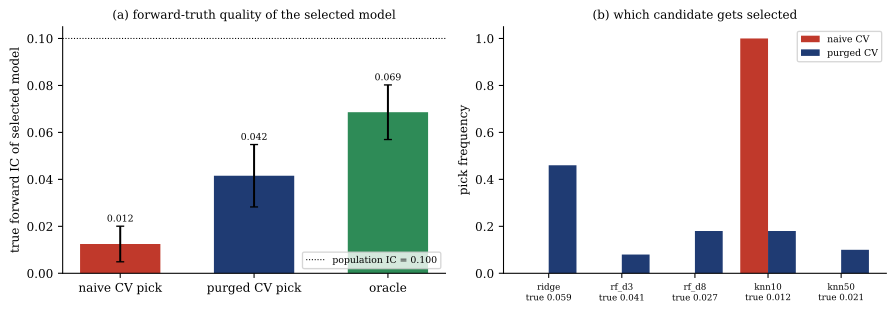
A biased estimate is survivable; a biased choice is not. The selection batch puts a genuine signal in the data (population IC 0.100) and lets each CV scheme choose from a five-model menu whose true forward skills we measure exactly. Table 4 and Figure 4 report the outcome.
| CV IC of pick | true IC of pick | optimism | regret | |
|---|---|---|---|---|
| naive shuffled k-fold | 0.422 \pm 0.011 | 0.012 \pm 0.008 | +0.410 \pm 0.012 | 0.056 \pm 0.011 |
| purged + embargo | 0.053 \pm 0.019 | 0.042 \pm 0.013 | +0.012 \pm 0.020 | 0.027 \pm 0.008 |
| oracle | — | 0.069 \pm 0.012 | — | 0 |
Naive CV does not merely overstate the chosen model’s skill—it chooses the wrong model, every time. In 50 of 50 repetitions it selects kNN with k=10, the most local model in the menu and, by the mechanism of Section 6.1, the best leakage harvester: with persistent features, a test point’s nearest neighbors in feature space are its temporal neighbors, whose overlapping labels contain the answer. The same locality that maximizes the leak makes it the menu’s worst true model (forward IC 0.012, against ridge’s 0.059). Naive CV claims 0.422 for this pick; its true skill is 0.012—an optimism of +0.410. (A small part of any CV-vs-truth optimism is a benign train-size effect—CV models train on 4/5 of the data while the truth refits on all of it—but that effect is shared by every splitter and is dwarfed here by the leakage term.) Under leakage, CV ranks models by their capacity to exploit the leak, which here is anti-correlated with true skill.
Purged CV repairs the decision, not just the number. It picks the truly best candidate (ridge) most often (23/50), distributes the rest across the menu (\text{RF}_{d8} 9, kNN_{10} 9, kNN_{50} 5, \text{RF}_{d3} 4), claims 0.053 where the truth is 0.042 (optimism +0.012 \pm 0.020, indistinguishable from zero), and cuts regret in half (0.056 \to 0.027 against an oracle of 0.069). The end-to-end payoff, the only number a practitioner ultimately cares about: switching the selection procedure from naive to purged CV raises the deployed model’s true forward IC by +0.029 \pm 0.012, with purged winning in 64\% of repetitions, tying in 18\%, and losing in 18\%. On a population signal of 0.100, the choice of validation scheme is worth more than a quarter of the signal itself.
Discussion
The reconciliation.
The two literatures that motivated this study are both right, about different regimes, and the experiment locates the boundary. [5]’s validity result and the empirical pro-CV findings [4, 8] concern settings that live on the axes of Table 1: one-step labels (no overlap) or, more generally, no mechanism by which a model can look up a test sample’s label content from training points. The financial-ML warnings [15] concern the product region: multi-period forward labels and features persistent enough to index temporal neighborhoods. Neither overlap nor persistence alone is dangerous; their product is, and it grows quickly (+0.31 already at h=5, \phi=0.97 for a flexible model). The practical diagnostic is correspondingly simple: count overlapping train/test label-window pairs (our released checker does exactly this) and ask whether any feature is persistent enough to act as an index. If either answer is “no,” naive CV’s mean is fine in this mechanism’s terms; if both are “yes,” it is not—and no amount of averaging over folds will save it, since the bias is positive in every repetition.
A practical recipe.
The decomposition in Sections 6.2–6.4 supports an ordered prescription. (i) Always use contiguous folds. Blocking is free—no data discarded—and removes nearly all of the mean bias; shuffled folds on overlapping labels are indefensible. (ii) Purge for the guarantee. At h \ll T purging changes the mean estimate by approximately nothing, but it costs only 1.2\% of training candidates and converts “small by arithmetic” into “zero by construction”—insurance that becomes load-bearing exactly when h grows relative to the fold length, where the boundary arithmetic stops being second-order. For model selection, use purged CV unconditionally: that is where the bias becomes a wrong decision and where we measure the payoff (+0.029 forward IC). (iii) Treat the embargo as a measured response to return-derived features, not a default tax. In our design—exogenous features, the pure overlap channel—zero embargo left no residual optimism in any of the ten arms, and signal persistence up to 0.995 did not change that. The embargo’s justification is a different channel (features computed from returns echoing the test block), which we did not test; if your features are return-derived, measure the required embargo rather than assuming 1\%. (iv) Budget for pessimism. Honest contiguous CV under heavy overlap reads low (-0.01 to -0.10 in our arms) relative to true forward skill, and its dispersion is {\sim}20\% higher—costs of contiguity, not of purging. A practitioner comparing an honest pipeline against a remembered naive baseline should expect the honest number to look worse twice over: the phantom is gone, and the estimator is conservative.
Why the selection result is the important one.
Estimation bias can in principle be discounted by a sufficiently skeptical reader; selection bias cannot, because it changes which model exists downstream. The mechanism is adversarial in the precise sense that the leak is not noise added to all candidates equally—it is a reward for memorization capacity, so CV under leakage sorts the menu by the wrong criterion. Our menu makes this stark (the truly worst model wins 50/50), but the logic is general: any hyperparameter that controls locality or capacity (tree depth, k, bandwidth, attention window) will be pushed toward the leakage-maximizing end by naive CV on overlapping labels. This connects the split-induced channel measured here to the selection-induced channel of [2, 3]: leaky validation scores are exactly the kind of inflated, correlated trial statistics that multiple-testing corrections assume away.
Limitations
Our features are exogenous AR(1) processes; no feature is computed from past returns. This isolates the overlap channel cleanly but excludes the channel that motivates the embargo—return-derived features (rolling statistics of returns) whose post-test values mechanically contain test-block information. Our embargo-bought-nothing result therefore delimits, and does not refute, the embargo; testing the return-derived case with the same forward-truth protocol is the natural next experiment. Return innovations are Gaussian and i.i.d.; volatility clustering, fat tails, and regime shifts would interact with both the leak and the pessimism in ways we do not measure. Horizons satisfy h \ll T (h/T \le 2.5\%); when label windows are long relative to fold length, blocking’s boundary arithmetic stops being second-order, and purging’s mean contribution should grow—our claim that blocking suffices in the mean is a claim about the tested regime, not a theorem. The model set is small and standard (ridge, random forests, kNN, logistic); the leak’s magnitude is model-dependent, and more aggressive memorizers (boosting, nearest-neighbor ensembles, deep networks) plausibly absorb more. The calibration criterion involves a threshold (0.01) and a CI rule, both disclosed and fixed before the sweep. Finally, the population IC is derived in closed form only for a single signal feature, which is why the genuine-signal arms carry one; the IC is the primary metric throughout, with the sign-strategy Sharpe recorded as a secondary check.
Conclusion
We measured, against known ground truth, how much of financial machine learning’s purging prescription is load-bearing. The leakage it targets is real and large, but it is an interaction: overlapping forward labels and persistent features jointly produce phantom CV skill up to +0.56 IC under an exact null, while either ingredient alone produces none—which reconciles the textbook warning of [15] with the validity results of [5]; each describes one regime of the same surface. Of the remedy’s three components, contiguous folds do nearly all of the mean-bias work at h \ll T; purging costs 1.2\% of the training data and upgrades the arithmetic to a guarantee of zero overlapping pairs; the embargo, for exogenous features, bought nothing at any tested persistence —a negative result we report with its scope, since return-derived features are the case it exists for and remain untested here. The unambiguous payoff of purged CV is decisional: under leakage, cross-validation ranks models by their capacity to exploit the leak, selecting the truly worst candidate in 50 of 50 trials; purging restores honest selection and lifts deployed forward skill by +0.029 \pm 0.012 on a 0.100 signal. Use contiguous folds always; purge for the guarantee and for every selection decision; embargo when—and by how much—your features, not your habits, require it.
Reproducibility.
All experiments are deterministic given the released seeds. A single
command (python scripts/run_all.py) regenerates every
record and summary statistic—the file results/results.json
and four per-record CSV files—and the package’s figures module
regenerates every figure from those results; a companion script
(scripts/check_paper_numbers.py) asserts that every number
quoted in this paper matches the generated results. The splitters are
implemented from scratch, and the test suite includes an exhaustive
proof that the purged splitters produce zero overlapping train/test
label-window pairs on every tested configuration. The data-generating
process, splitters, evaluation harness, and analysis are provided as an
open-source package.
References
The splitting procedures under test, including the specific purge-and-embargo construction we implement, follow the author’s own earlier practitioner explainer on purged cross-validation (a marketmaker.cc article). The present paper is a controlled self-audit of advice the author has himself circulated, not an attack on a third party.↩︎